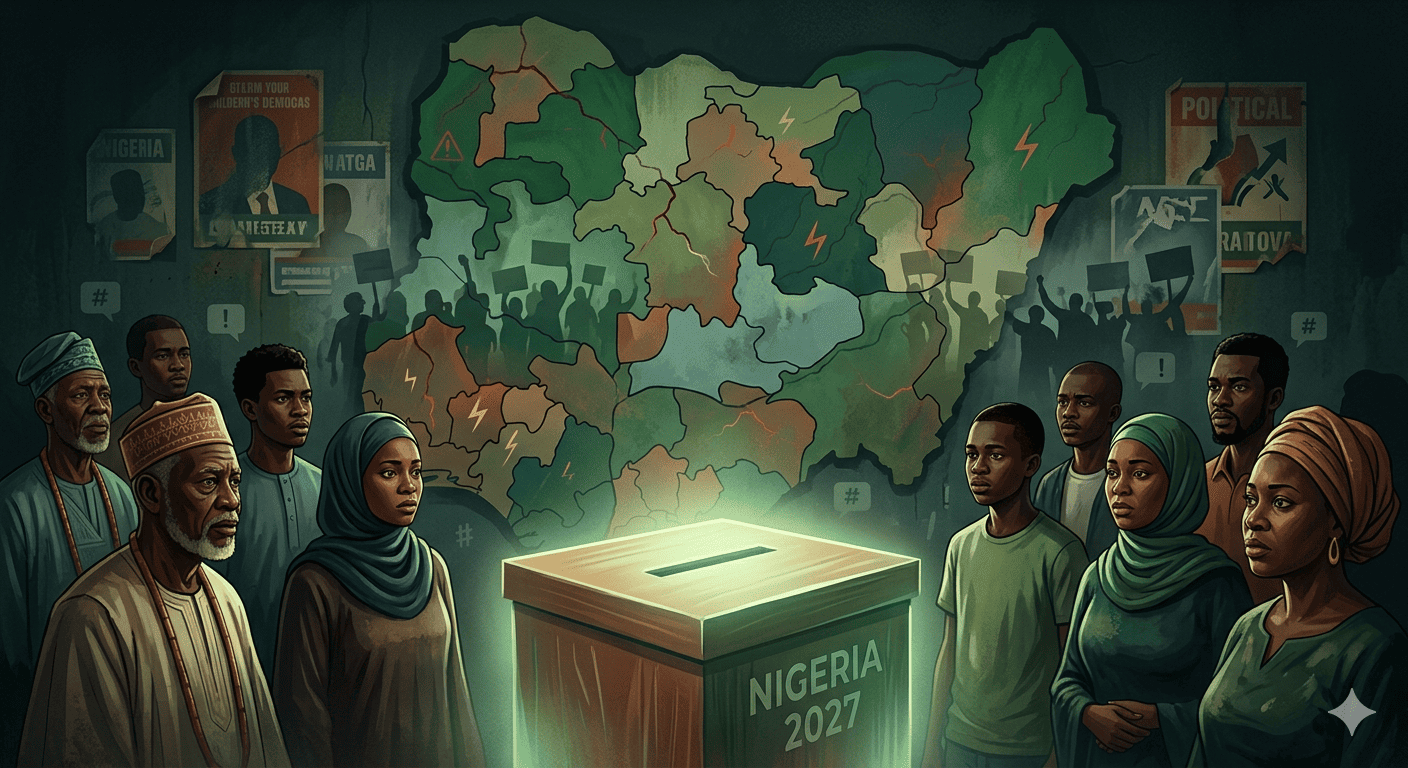
Nigeria’s next general elections are constitutionally scheduled for 2027. On paper, that timeline appears distant. In reality, early indicators of political temperature shifts typically surface 18–24 months before polling day. For security analysts and corporate risk managers, the question is not who will win in 2027. The more strategic question is whether early-stage volatility patterns are already visible.
The conduct of elections remains under the statutory oversight of the Independent National Electoral Commission (INEC), but the broader security environment is shaped by political actors, economic pressures and local power structures across the federation. Historically, pre-election periods in Nigeria have correlated with spikes in targeted violence, political thuggery, disinformation campaigns and localized communal tensions.

A review of previous election cycles, particularly 2011, 2015, 2019 and 2023, shows a consistent pattern. Heightened rhetoric begins at elite level. That rhetoric gradually filters down through party structures into local mobilization networks. Where economic hardship is acute and youth unemployment remains high, mobilization can quickly morph into confrontation.
A useful contemporary reference point is the recently concluded Area Council elections in the Federal Capital Territory (Abuja), which offered an early micro-level glimpse into Nigeria’s evolving electoral environment. Although local in scope, the contest attracted unusually high political attention from national party structures and revealed several dynamics that often precede larger electoral cycles: heightened partisan messaging, aggressive grassroots mobilization and disputes around results management at the ward level. Observers also noted the growing influence of social media narratives in shaping voter perception and amplifying allegations before official clarification by the Independent National Electoral Commission (INEC). While the elections themselves did not trigger large-scale violence, the intensity of political competition within the capital illustrates how even sub-national contests can become testing grounds for mobilization strategies, communication tactics and political alliances that may later scale into national campaigns. For analysts monitoring early warning signals ahead of 2027, such localized elections provide valuable insight into how political actors are refining their operational playbooks well before the general election cycle formally begins.
Several early warning signals are worth monitoring at this stage.
The first is rhetoric escalation. Political language that frames opponents as existential threats rather than competitors tends to precede instability. When campaign narratives shift from policy debate to identity framing along ethnic, regional or religious lines, the probability of localized unrest increases.
The second is intra-party fragmentation. As aspirants begin positioning for primaries within major parties, factional disputes can generate violence long before the general election. Monitoring defections, litigation battles and parallel party congresses provides insight into future flashpoints.
The third is youth mobilization without structured oversight. Nigeria’s demographic profile remains heavily youth-dominated. In environments such as Lagos, Kano and Port Harcourt, political gatherings can scale rapidly. Where economic frustration intersects with political messaging, mobilization energy can be redirected toward street-level confrontation.
The fourth is disinformation velocity. The 2023 election cycle demonstrated the growing influence of coordinated online narratives. False results, fabricated endorsements and manipulated video content circulated widely before official clarification from INEC. In 2027, artificial intelligence–enhanced media manipulation could accelerate that trend. The time gap between rumor and correction may narrow further, increasing tension in sensitive states.
The fifth signal is localized security redeployment. Increased movement of security personnel into politically sensitive states can be a double-edged indicator. While preventive in intent, visible militarization sometimes heightens public anxiety, particularly in historically volatile areas such as Rivers State and Kano State.
Economic conditions will also play a decisive role. Persistent inflation, currency volatility and subsidy reforms continue to shape public sentiment. When economic hardship aligns with political contestation, protest risk increases. Nigeria’s 2012 fuel subsidy protests and the 2020 #EndSARS demonstrations illustrate how quickly economic grievances can converge with governance dissatisfaction. If economic recovery stabilizes by late 2026, election-related volatility may be contained. If hardship persists, political actors may find a more combustible environment.
Importantly, Nigeria’s security institutions have demonstrated learning capacity. Compared to 2011, election security coordination improved significantly in 2015 and again in 2023. Inter-agency collaboration, early deployment strategies and result transmission reforms have reduced certain categories of violence. However, non-state actors have also adapted. Rather than mass clashes, recent cycles show micro-targeted intimidation, suppression tactics and strategic misinformation.
From a corporate risk perspective, the 2027 cycle should be treated as a phased exposure window rather than a single-day event. Risk typically increases during four periods: party primaries, candidate announcements, final campaign rallies and post-result litigation windows. Businesses operating in politically competitive states should begin scenario planning by mid-2026 at the latest.
For policymakers, early intervention remains the most effective mitigation strategy. Transparent communication from INEC, swift prosecution of political violence and cross-party peace accords can significantly dampen escalation. For civil society, voter education and digital literacy campaigns may reduce susceptibility to manipulated narratives.
Nigeria is not predetermined to experience election violence in 2027. The trajectory will depend on economic stabilization, political restraint and institutional credibility. What history suggests, however, is that warning signals rarely appear suddenly. They build gradually, often dismissed as routine political noise until an incident crystallizes broader tension.
The strategic question is therefore not whether 2027 will be peaceful or volatile. It is whether stakeholders are paying attention early enough to the signals that precede both outcomes.
At this stage in the cycle, are we observing routine political positioning, or the first indicators of elevated electoral risk?